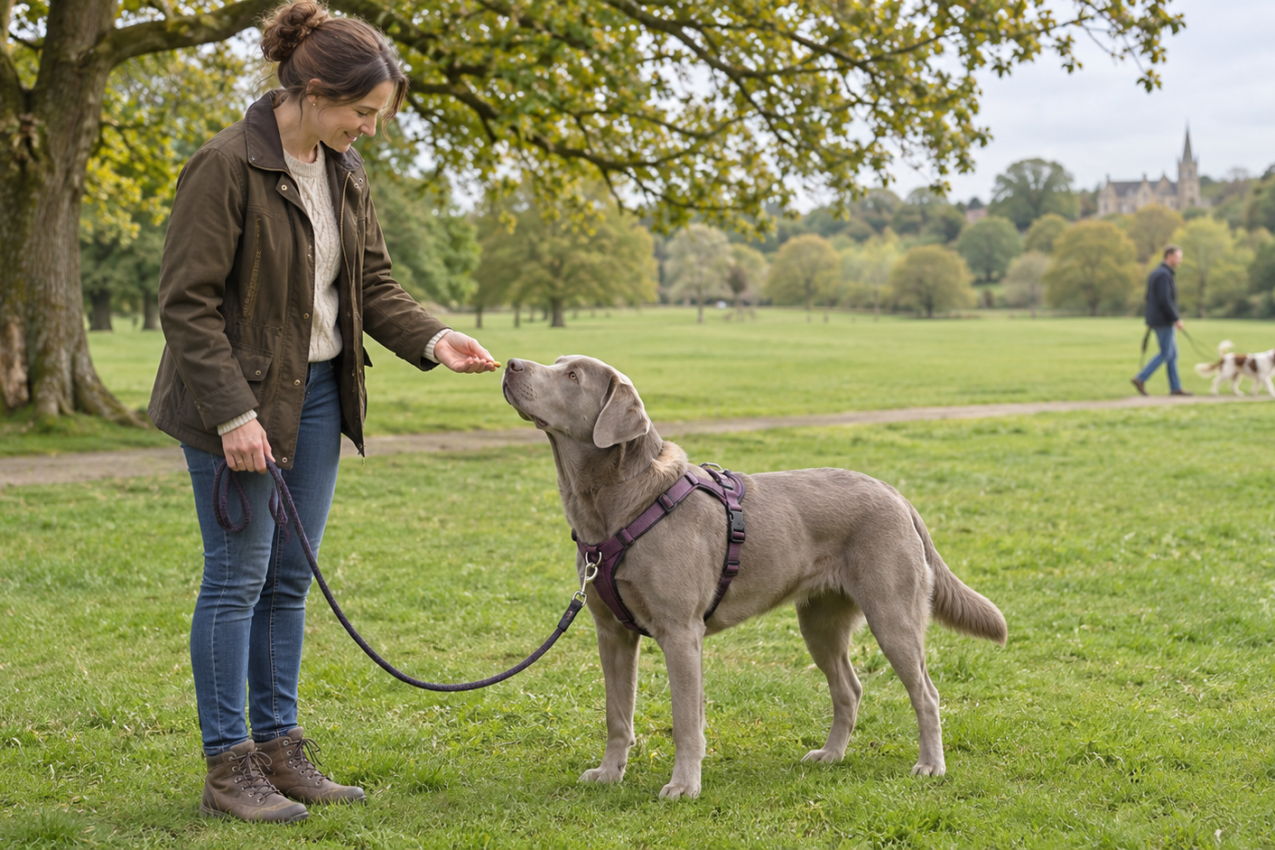
Caitlin Neeson has worked with dogs for 9 years and is a trainer at our Oxfordshire centre. A dog barking at other dogs on walks is one of the problems she sees most often, and the cause is not always what owners assume.
The barking is only the symptom. Fixing it starts with understanding what your dog is feeling when it happens.
Why does my dog bark at other dogs on the lead?
Dogs bark at other dogs on walks because they are excited, worried or frustrated, as Dogs Trust’s advice on reactive dogs explains. Body language and context give the best clues to which it is.
Caitlin’s first check is always body language. “It’s your cheatsheet into how your dog is feeling,” she says, and the same cue can mean different things in different situations. A wagging tail, for example, does not always mean a happy dog, a point also made in the American Kennel Club’s guide to reading dog body language.
- Excitement. The dog wants to say hello and gets worked up as the other dog approaches. For some dogs, barking can be part of a build-up of arousal that starts before the walk, as Caitlin has seen in her own work.
- Fear or worry. The dog may be trying to create more space from the other dog.
- Frustration. The dog wants to reach the other dog but the lead stops it, so the energy comes out as noise.
Look at the whole picture: posture, tail, ears, mouth, how your dog moves towards or away from the other dog, and the context, such as the distance, the lead and what happened just before. Some owners find filming a walk helpful. Ask your vet or behaviourist whether it would be useful. If you are unsure what you are seeing, ask a qualified trainer or behaviourist. Knowing the cause helps you and your trainer choose the best approach.
What should I do when my dog barks at another dog?
Most owners want to pull the dog back and say “no”. It’s a natural reaction, but in Caitlin’s view it doesn’t show your dog what you would like them to do instead.
A dog that is already worked up is unlikely to learn what you want from being told off, and it may add to its stress. Keep the lead loose, calmly create more distance from the other dog, then reward your dog when it is relaxed.
How do I stop my dog barking at other dogs while out walking?
Caitlin’s approach is distance first, rewards second, distractions last. Keep sessions short and stay far enough from other dogs that your dog can still think. Practise little and often, not in one long walk.
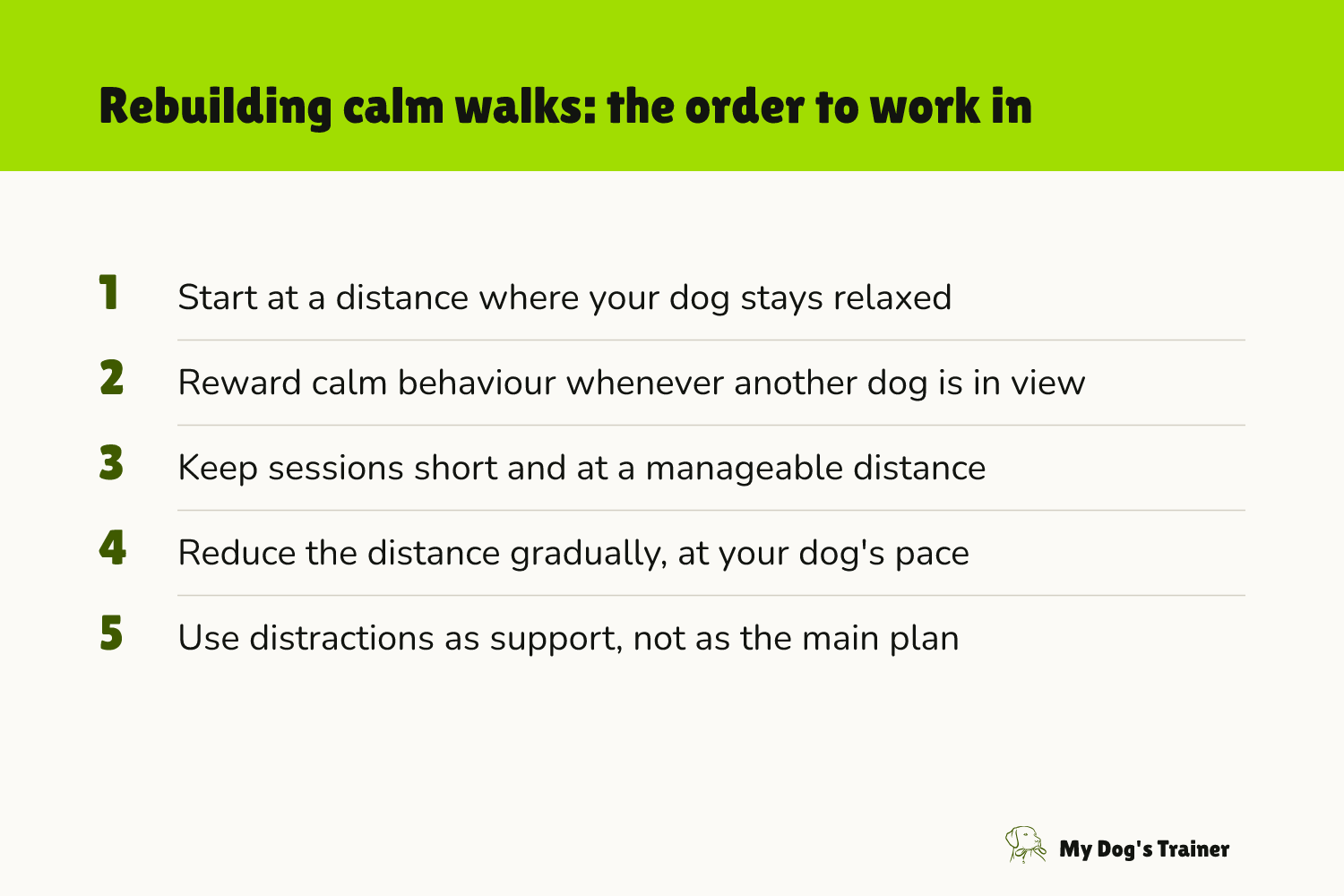
- Start with distance. Caitlin stresses this above everything else: the more space you have, the calmer your dog will be. Start at a distance where your dog stays relaxed and can take treats, and only reduce it gradually at your dog’s own pace.
- Build value around other dogs. Reward your dog for staying calm while another dog is in view, so the sight of one starts to predict something good. This changes how your dog feels, not just how it behaves.
- Keep sessions short. Short, bite-sized sessions at a manageable distance work best. Too many tasks and expectations at once cause frustration, which is what you are trying to reduce.
- Adjust to your dog. There is no universal distance or session length. It depends on the individual dog, so watch your dog and move closer only when it is relaxed.
- Use distractions carefully. They can be beneficial, but they don’t tackle the problem directly. Treat them as a support, not the plan.
- Watch the lead-up. Some dogs are more likely to react if they start the walk already wound up, so notice how your dog behaves before you leave the house.
Our guide on how to manage a reactive dog covers keeping your dog below the point where it reacts.
What is the 3 bark rule?
The “3 bark rule” is sometimes used to describe allowing a few alert barks before giving a trained cue for quiet. For barking at other dogs on walks, Caitlin’s advice is to focus on why your dog is reacting, create more distance and reward calm behaviour.
The aim is to help your dog feel calmer around other dogs through good experiences at a distance, rather than simply limiting the number of barks.
A Silver Labrador that was over-stimulated before the walk even began
Caitlin recently worked with a seven-and-a-half-year-old Silver Labrador. He became so stimulated while getting ready to go out that it showed up as reactivity during the walk itself.
She worked on lowering his baseline level of stimulation. It changed his attitude outside. For some dogs, the problem on the walk starts well before they meet another dog.
When should I get professional help?
Get help if your dog’s barking isn’t improving or you can’t tell why it is happening. Seek help sooner if your dog is aggressive, is hurting someone or seems distressed. The right professional depends on the cause.
If your dog barks because it doesn’t know what it’s supposed to do, or what you want from it, structured or residential training can work wonders. Our Standard course covers on-lead reactivity within its 2-week stay, and you can see where we work at our Oxfordshire centre.
If your dog is barking because it is hurting or is aggressive, start with a vet or a behaviourist first. Your dog needs to be in the right headspace to learn. Not sure which route fits? You can send us an enquiry and we will talk it through.
Key takeaways
- Read your dog’s body language and context first: knowing the cause helps you and your trainer choose the best approach.
- Calmly creating more distance, then rewarding relaxed behaviour, is better than pulling your dog back and saying “no”.
- Caitlin works on distance first, then rewards, then distractions.
- Keep sessions short and at a distance your dog can manage.
- If pain or aggression may be involved, see a vet or behaviourist before any training.
Frequently asked questions
Why does my dog bark at other dogs on the lead but not off it?
On the lead your dog can’t move away or approach freely, which can increase fear or frustration. Some dogs behave differently off the lead, but a reactive dog shouldn’t be let off to meet other dogs. Get advice from a qualified trainer or behaviourist first.
How far away should another dog be when I start training?
It depends on your dog. Start at a distance where your dog stays relaxed and can take treats. The more space you have, the calmer it will be. Reduce the distance gradually, at your dog’s own pace.
Is the 3 bark rule enough to stop the barking?
On its own, no. Caitlin thinks it needs regular practice and should be used alongside other techniques and management, such as distance and rewarding calm behaviour around other dogs.
Can residential training fix a dog barking at other dogs?
It can if your dog barks because it doesn’t know what you want from it. If the barking comes from pain or aggression, see a vet or behaviourist first so your dog is ready to learn.